
In The Last Lion, the sanitized historical narrative of Winston Churchill is utterly demolished by William Manchester’s own account. The biography strips away the propaganda that exposes Churchill’s deep, toxic ties to the titans of American finance right before the 1929 crash. The cash, collusion, and catastrophic timing are documented in cold, hard ink. Ultimately, this author’s own writing is going to backfire on hypocrites like him, blowing the lid off the shadowy interests pulling the strings of global history.
Excerpt from The Last Lion by William Manchester (Pages 824–828):
On August 3, 1929, the Empress of Australia steamed out of Southampton, bound for Quebec. Among its first-class passengers were Churchill; his brother, Jack; Randolph, now eighteen; and Jack’s young son Johnny. Winston spent most of the voyage working or attending to his personal exchequer. He wrote two pieces, “Will the British Empire Survive?” for Answers, and a profile of a peer for Nash’s Pall Mall. John Bull had already paid him for a piece on the election, “Why We Lost.” The Daily Telegraph had agreed to pay him £2,500 for ten articles on this trip. In addition, £1,000 in World Crisis royalties had arrived before he left London, and a sale of utility shares had brought him another £2,000. He invested every shilling he could spare in the New York stock market. Financial security, he wrote Clementine from the ship, was “a wonderful thing.”²⁴⁵
The warmth of his Canadian welcome was also wonderful. “The workmen in the streets,” he wrote her, “the girls who work the lifts, the ex-service men, the farmers, up to the highest functionaries have shown such unaffected pleasure to see me & shake hands that I am profoundly touched.” The Canadian Pacific had put a stenographer-typist at his disposal for the journey across the continent, and Bernard Baruch had persuaded Charles Schwab to lend Churchill his private railway car, with double beds, private bathrooms, a parlor, a dining room (which Winston converted into an office), a kitchen, servants’ quarters, a refrigerator, fans, and a radio. The radio, he wrote Clementine, was especially useful: “The wireless is a great boon, and we hear regularly from [Horace] Vickers [his broker] about the stock markets. His news has, so far, been entirely satisfactory.” The passing scenery fascinated him. He wrote that he wanted “to see the country at close quarters, and nibble the grass and champ the branches.” To Randolph he said, “Fancy cutting down all those beautiful trees to make pulp for those bloody newspapers and calling it Civilization.”²⁴⁶
Along the way he paused to open exhibitions, dedicate memorials, consult with officials, and deliver speeches, in one of which he deplored proposals to reduce France’s army, reminding his audience that Germany had twice as many youths of military age as France, which had been invaded by Germans twice within living memory. After driving across the Rockies, which he painted, a sombrero shielding him from the sun, they visited Vancouver and took the ferry to Victoria, their last Canadian stop. The next day Randolph wrote in his diary: “We are now on the ship bound to Seattle, American soil and Prohibition. But we are well-equipped. My big flask is full of whisky and the little one contains brandy. I have reserves of both in medicine bottles. It is almost certain that we shall have no trouble. Still if we do, Papa pays the fine and I get the publicity.” Papa would have been hit by both; he had a case of brandy in stone hot-water bottles. In San Francisco the British consul general met their train and drove them southward through the redwoods. Winston wrote his wife that the greater part of their six-hundred-mile journey “lay through the woods with these enormous trees. They are really astonishing. One we saw, the biggest, 380 foot high, was three thousand or four thousand or even five thousand years old and it took fourteen of us to join our arms around its stem.”²⁴⁷
The high point of their California trip was a four-day visit with their chief California host, William Randolph Hearst, a fervent anglophobe who nevertheless wanted Churchill’s by-line in his papers. Winston was willing, though he drove a hard bargain: £40,000 for twenty-two pieces. He was dumbfounded by San Simeon, Hearst’s thirty-million-dollar castle. Blenheim pales beside San Simeon, a composite of all the European palaces and cathedrals the owner had admired, with tapestries, sarcophagi, stained glass, corbels, choir stalls, Gothic rooms, carved staircases, fretwork-ornamented towers, stables, swimming pools, and tennis courts. The entire property was surrounded by a transplanted forest. The man of the house dwelt in a third-floor “Celestial Suite,” from which he descended in an elevator whose walls were hung with priceless paintings. Winston was charmed by Hearst’s mistress, Marion Davies, formerly an MGM star, and enchanted when they all went off on a picnic accompanied by sixteen pack mules loaded with caviar, champagne, and a hillbilly band. Of Hearst himself, Churchill wrote home that he was “most interesting to meet, & I got to like him — a grave simple child — with no doubt a nasty temper — playing with the most costly toys. A vast income always overspent: ceaseless building & collecting not vy discriminatingly works of art: two magnificent establishments, two charming wives [Mrs. Hearst and Marion]; complete indifference to public opinion, a strong liberal and democratic outlook, a 15 million daily circulation, oriental hospitalities, extreme personal courtesy (to us at any rate) & the appearance of a Quaker elder — or perhaps better Mormon elder.” One afternoon the householder was conferring with his attorney when a maid rushed in. “Mr Churchill is fainting!” she cried. “He wants some turpentine!” Hearst rushed out to a terrace, where he found Winston painting, not fainting, awaiting a thinner for his oils and placidly puffing a fat cigar.²⁴⁸
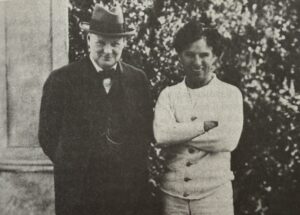
Churchill visits Charlie Chaplin at his Hollywood studio
Churchill and his party moved on to Santa Barbara and then, for five nights, to the Biltmore in Los Angeles — their hotel bills, Winston wrote, were paid by “a hearty Banker” — where they toured the Hollywood studios and were Hearst’s guests once again, at the Montmartre Club. That evening they dined with sixty guests, including Charlie Chaplin. Winston wrote his wife that Chaplin had “acted his new film for us in a wonderful way. It is to be his gt attempt to prove that the silent drama or pantomime is superior to the new talkies.”* Randolph noted in his diary: “Papa wants him to act the young Napoleon and has promised to write the Scenario.” Instead, said Chaplin, he intended to play Jesus Christ. Churchill thought a moment and then asked: “Have you cleared the rights?”²⁴⁹
After a fishing expedition off Catalina Island (Winston caught a 188-pound swordfish in twenty minutes), his party proceeded eastward, again in Schwab’s private car, across the Mojave Desert, by the Grand Canyon, to Chicago. Baruch met him at the station there and introduced him to the Commercial Club. Asked about Ramsay MacDonald, who was also in the United States at the time, negotiating naval disarmament, Churchill replied that England was fortunate to be represented “by so experienced a statesman and so distinguished a man” — and then called for more British and American warships. On the Atlantic coast he paid a courtesy call on Herbert Hoover; toured Civil War battlefields, to pick up material for a series of Collier’s pieces; and was in New York, staying at the Savoy-Plaza Hotel, when the market crashed. Still shaky on economics, he was slow to grasp what was happening. On the evening of “Black Tuesday,” when the stock market, honeycombed with credit, collapsed of its own weight, sixteen million shares changing hands, he dined at Bernard Baruch’s Fifth Avenue mansion. The other guests were bankers and financiers. When one rose to toast their British visitor, he addressed the company as “friends and former millionaires.”²⁵⁰
The next morning Churchill heard shouts below the Savoy-Plaza apartment and looked out, he wrote, to find that “under my window a gentleman [had] cast himself down fifteen storeys and was dashed to pieces, causing a wild commotion and the arrival of the fire brigade.” Ever the curious journalist, he made his way to Wall Street. There, recognized by a stranger, he was invited inside the Stock Exchange. “I had expected to see pandemonium,” he wrote, “but the spectacle that met my eyes was one of calm and orderliness.” No wonder; apparently he hadn’t been told that brokers are forbidden to run on the floor of the exchange, and the big sellout was over anyhow, stocks now being offered for a fraction of their value. Churchill concluded: “No one who has gazed on such a scene could doubt that this financial disaster, huge as it is, cruel as it is to thousands, is only a passing episode in the march of a valiant and serviceable people who by fierce experiment are hewing new paths for man, and showing to all nations much that they should attempt and much that they should avoid.”²⁵¹
He still hadn’t made the connection, still didn’t grasp that since September 3, when he had left Vancouver, Wall Street investors had lost over thirty billion dollars, almost as much as the United States had spent on World War I. Later he would realize that this “Economical Blizzard,” as he came to call it, was responsible for turning all England into “one vast soup kitchen,” driving the country back off the gold standard, doubling the number of British unemployed, and radicalizing politics throughout Europe, especially in Germany. In California, coming under the spell of a local stockbroker, he had been persuaded to speculate heavily. The Wall Street fever of that autumn had afflicted him; he had written his wife: “Since my last letter from Santa Barbara I have made another £1,000 by speculating in a stock called Simmons. It is a domestic furniture business. They say, ‘You can’t go wrong on a Simmons mattress.’ There is a stock exchange [ticker] in every big hotel. You go & watch the figures being marked up on slates every few minutes. Mr Van Antwerp advises me. He is a stockbroker & one of the leading firms. I think he is a vy good man. This powerful firm watch my small interests like a cat a mouse.” William Van Antwerp was a member of E. F. Hutton, a reliable company, but the most stable brokers were impotent in the panic selling of Winston’s last week in New York. Though he had not been wiped out, his financial independence had disappeared in the reams of ticker tape. Throughout the coming decade he would have to write furiously to keep his family and style of living afloat. This bleak dawn was just beginning to break upon him when he sailed from New York on October 30. But when he reached Southampton he momentarily forgot it. A more immediate threat hung over the world he loved. Lord Irwin,* the new viceroy in New Delhi, had recommended “the attainment of Dominion status” as Britain’s goal for its Indian Empire, Labour had endorsed Irwin’s proposal, and so, without consulting other leaders of the Conservative party, had Stanley Baldwin.²⁵²